The Long Way Round
A stranded cat familiar and their diverse friend circle must catch up to a monster who used to be a person.
The Long Way Round is a single player, low-stakes trading game set in a magical hub that is visited exclusively by animal familiars of magic users who travel through a gateway into a dreamlike space, floating amongst stars. This is where cryptids, deities of old and magical creatures arrive to barter. The gameplay revolves around determining the needs of the visiting traders, gathering the requested items through light platforming and cooperative traversal and completing exchanges that feel more like acts of care than commerce.
Helping feels good, it is not obligatory.
Wonder before explanation.
Cooperation over competition.
Every character has dignity.
The world is safe.
Warm, understated and a little whimsical. Dialogue is short and slightly overlapping. No one lectures. Exposition is earned through curiosity, not cutscenes.
The visual aesthetic reads as "technology so advanced it is indistinguishable from magic". Clean form, soft light, no grime.
Urgency as manipulation. Condescension. Sad animal content. Jokes that require cynicism. Any dialogue that would feel out of place read aloud to a 10-year-old.
Casual spoken language. Characters are allowed to be deadpan, but never mean. The animal characters communicate audibly in normal animal sounds that all characters can understand, and the UI translates it all into English for the player.
Arrival
First gateway crossing. The player gets an informative tutorial via Blen's lack of experience and questions. A friendly creature's platform departs after some successful trading. There is an easy fetch quest. First Home Interlude. The world is established as generous and safe.
Commerce & Community
A new docking places a platform in quarantine when there appears to be no sign of life. 2-3 escalating trade missions fill the waiting period. The Hub starts feeling like a second home. When the quarantine clears, the familiars explore the new space and accidentally release Evadne in her monster-form.
Disruption & Understanding
Evadne's realisation and rage causes the gateway to break when she escapes through it. Aaliyah reveals her private exit. The familiars pursue Evadne and once found, bring her back to the Hub, exhausting her in the process. This process reveals the person she was before she was consumed by her hatred.
The tonal contract of the game must survive into Act III. The threat is disruption, not destruction. Resolution arrives through cooperation, persistence, and a willingness to keep showing up. Understanding Evadne is part of solving the problem, and the resolution should feel like every earlier mission was practice for this one.
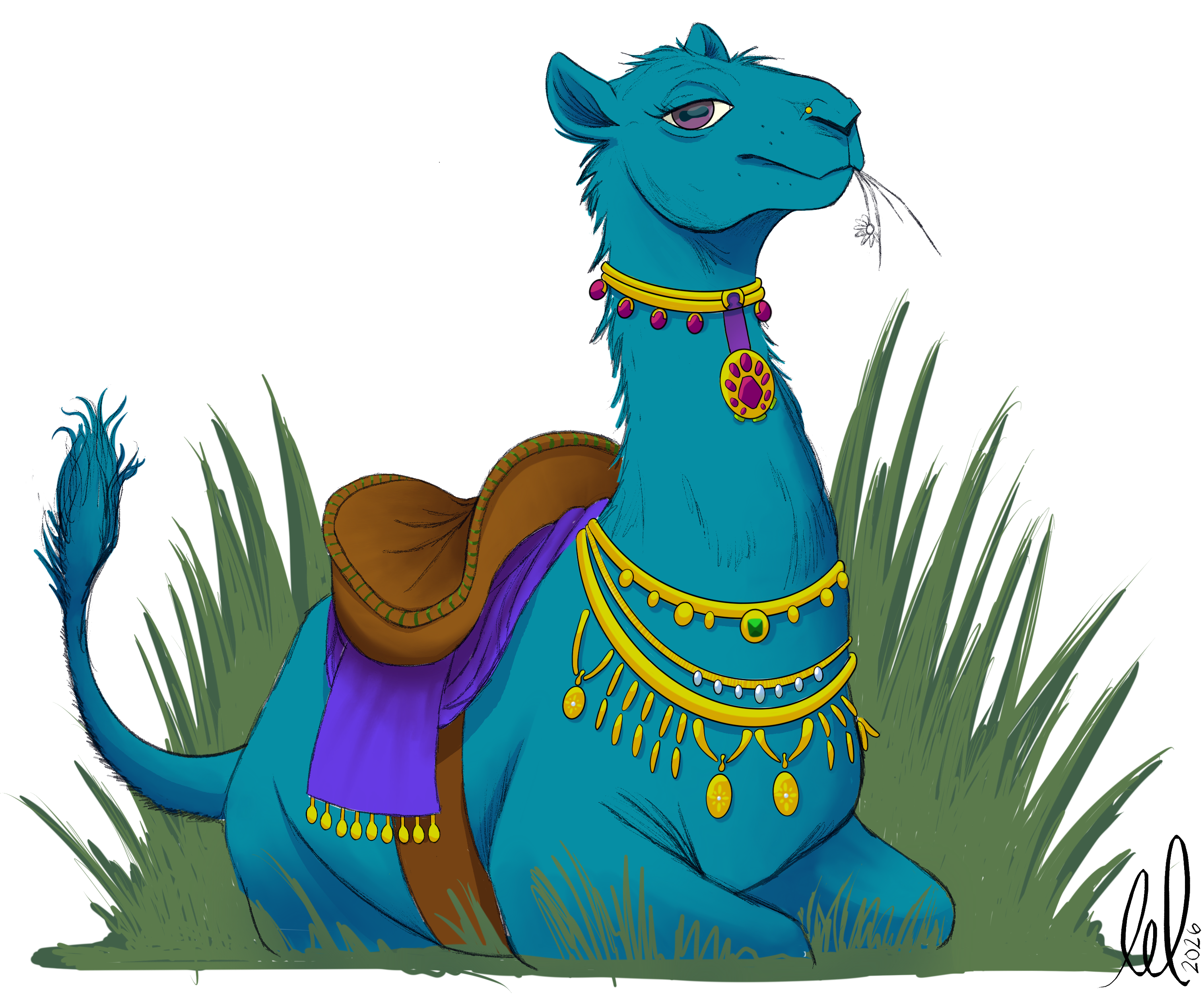 Aaliyah · Background Fixture · Act III Key
The Cat
Protagonist · Player AvatarCustomizable appearance and name. The Cat is an experienced familiar with a lot of stamina and bravery. They are the glue that keeps the friend group together. They are also the one who ultimately gets through to the Antagonist.
Blen (rat)
Audience SurrogateHis questions are the tutorial. His arc: gaining confidence through Acts I and II.
Steve (crow) & Pagosi (raven)
Capable PeersCapable peers. Steve is the traversal assist character. Pagosi is the comedic relief.
Crystal (racoon) & Charlotte (toad)
Traversal ExpertsTraversal-unlocking familiars. Distinct voices; roles to be developed across missions.
Aaliyah (camel)
Background Fixture · Act III KeyBackground fixture through Acts I and II, always chewing, seemingly decorative. In Act III she reveals a private gateway built for her by her human companion and carries the group through it. Her quiet presence and her partner's gift form a silent counterpoint to the antagonist's story.
Evadne Costelly
AntagonistTrapped witch turned rage-creature. Her grievance is legitimate; her methods are not. She is the antagonist and, eventually, the most sympathetic character in the game.
Station Visitors
TradersEach of these characters are themed to their platforms. Lesser known Egyptian gods, mermaids, werewolves, ghosts - the visitor roster is deliberately eclectic. They communicate via gestures and the provided tablet interface only, as there is no shared language.
The player's witch partner exists in the Home Interlude. They send their familiar through the gateway with their own item requests, for potions and other things. They and their familiars are equals, partners in a shared life. Not keepers and kept, but friends. The cat's witch partner is human and when the familiars discover that Evadne is also human, that connection matters.
Evadne Costelly
Witch. Rule-breaker. Prisoner. Monster. Person.
A witch who entered the magical hub illegally to access its rare ingredients, the best ingredients, the ones unavailable anywhere else in the human world. She knew it was forbidden but she came anyway.
Another witch discovered her trespass and sealed her on a platform as punishment. The curse was delivered with the line: "You like it in there so much? Stay." The person who said it is long dead. Evadne is not.
She hates witches, all of them, indiscriminately despite being one of them. Her hatred has expanded to cover the entire category of person who wronged her, and she will go for the player's witch partner specifically because of that connection.
She broke the oldest rule of this world. That humans do not belong in magical realms. She was punished for it, and that punishment made her into the most destructive force the Hub has ever seen. The rule she broke is the same rule that proves her original wrongdoing. She did, in part, do this to herself and she will have to reckon with that.
Sticky, dark, tar-like. In her monster form, things she passes by adhere to her and become part of her: plants, debris, objects from the platform she was trapped on. She is still collecting, even now. Her greed did not stop; it just changed shape. When exhausted by the familiars in the final confrontation, the tar recedes and a normal woman is revealed underneath.
When Evadne escapes from her platform, the gateway does not close because she wills it. It breaks because of her, because the force of decades of contained rage radiating outward is simply too much for the infrastructure to take. She doesn't even notice as it's happening. She doesn't consider that she might be leaving helpless animals stranded.
Through the power of teamwork, she is exhausted into clarity. The exhaustion matters: this is not a villain who is argued out of her position or moved by a speech. She simply runs out of the energy required to stay a monster. What remains, when the tar recedes and the rage quiets, is a woman who has been alone for a very long time.
The recognition that arrives in that moment is not redemption. It is something smaller and more honest: the realisation that those that she has been going after were not the people who wronged her. Her grievance was real. Her aim was not. She does not need to forgive anyone. She just needs to stop.
She leaves. She tries to live a normal life. Whether she manages this is left open but the game should make it clear that her trying is its own form of bravery, and that it is harder than anything she ever did as a monster.
When Evadne's tar form recedes, the familiars are confronted with a human woman, something that has never existed in this realm before. The Hub is for magical creatures and familiar companions only. This is how it has been since the beginning. The shock should land as cathartic: the monster was a person. A person who broke a rule, paid a price that vastly exceeded the crime, and spent decades as something terrible as a result. The familiars have been fighting grief wearing a costume.
Each familiar is tagged on their first gateway traversal, binding them to this Hub permanently. This explains why familiars cannot visit other Hubs. The other Hubs can be seen floating in the distance above and are unreachable by design. They are present as atmosphere and a deliberate seed for future expansion. In Act III, when the gateway is broken by Evadne's passage, the system becomes the source of the crisis. The familiars can't go home because the only way out they are aware of is gone.
Aaliyah has a private second gateway, built for her specifically by her witch partner. The gateway must be kept a secret until the third act.
The docking process is electronic. Magic rules the realm, but the entire process of platforms docking or departing the Hub is a feat of engineering. When a platform arrives, the being on it must confirm a successful arrival; if they do not, then the platform is placed in quarantine. Each docking advances the player's understanding of the world's rules.
The Hub has screens at each crossing and docking station that help clarify what each visitor is searching for. These screens are part of the quest UI and this keeps the HUD integrated into the realm.
Station visitors use a tablet that mirrors the terminal's visual language. Language barriers are solved through pictures and gesture, never a shared tongue. This respects the creatures' otherness and keeps communication visual and readable.
A circular timer on the dock gate with slices disappearing over time. This helps visualize the Hub's security rules, creates low-grade anticipation and gives the player 2-3 trade missions of breathing room before everything changes.
Fetch missions sometimes require abilities the Cat does not have alone. Steve's flight, Blen's small size and Charlotte's ability to jump long distances can be very helpful at times. Every ability-lending moment must feel like a character beat.
All familiars are protected by their bond to their witch partner. Evadne cannot harm them directly, but she can go after the witch partners on the other side of the gateway. This rule should be seeded casually in Act I as interesting lore, then become urgently relevant when the familiars realise what Evadne is actually after.
Each docked platform is an impossible space. Larger inside than out and themed to its occupant. The quarantined platform's interior reflects Evadne: overgrown, half-burnt, full of jars and tinctures and decades of passive collecting.
Arrive at Hub (low energy, social reconnection), receive quest (mild excitement), traverse platform (escalating challenge), complete trade (resolution), return home or linger (decompression).
Placed between Acts I and II. A mandatory exhale that resets emotional stakes, re-anchors the cat's motivation, and makes the Hub feel like a destination rather than a default.
The sealed platform sits in peripheral vision for the entirety of Act II. It should be visible from the Hub but never foregrounded: a background note, not a drumbeat. Players paying attention will feel its weight. Players who are not will be surprised when it becomes available.
She must be visible and unremarkable through Acts I and II. Her Act III revelation works only because the player has been gently overlooking her for the entire game. Do not foreshadow. Let her simply be there.
The gateway break is the highest consequence state in the game. The emotional register: someone you love is potentially in danger and you need to fix this so you can get back to them. The resolution should arrive through the same tools as every other mission.
The game's tonal contract requires that failure never feel punishing. Mechanical failure states (falling, missing a jump, dropping an item) should respawn the player quickly, without fanfare and close to the point of failure. The game does not linger on failure.
Narrative failure, such as missing a departing visitor or failing to complete a trade in time, should result in a deferred outcome, not a lost one. Visitors will eventually return. No quest is permanently missable. The ensemble's response to a missed platform is light disappointment and forward thinking, not distress.
The Act III gateway break is the game's largest consequence state and it should feel genuinely inconvenient without ever feeling dangerous. The familiars are protected. What is at risk is time, comfort, and the people waiting for them at home. That is the right level of stakes for this game and it is a level that Evadne's story, once understood, accomplishes. She lost decades. The familiars lose an afternoon. That asymmetry is part of why the resolution has to include some compassion for her.
The long way round is still the way home.
✴